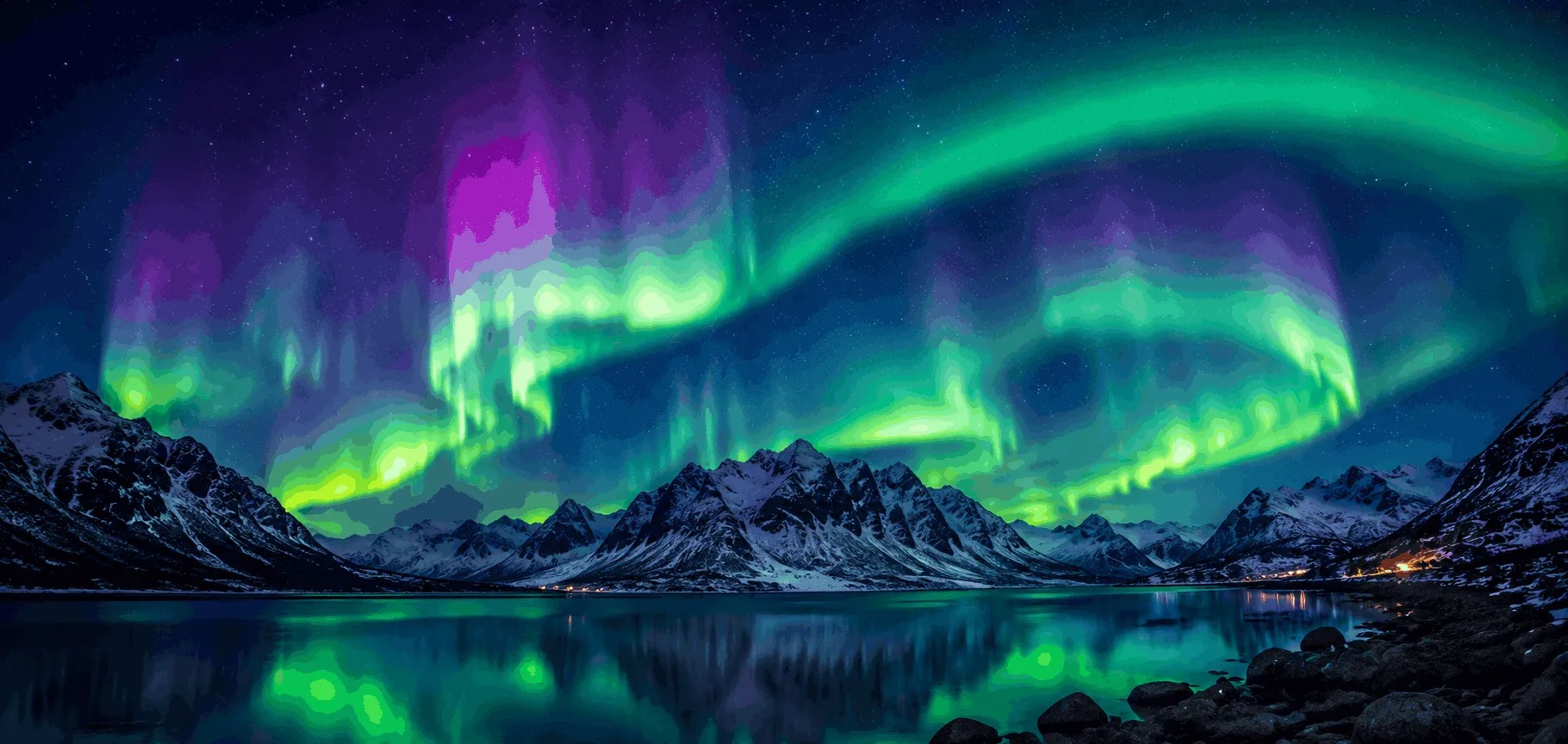
On the night of May 10, 2024, residents of Texas, Florida, Mexico, and even northern India looked up and saw something they had never seen before — the aurora borealis, dancing in skies that had not witnessed northern lights in living memory. That single night, scientists later named the Gannon Storm, marked the most intense geomagnetic event in 21 years and confirmed what space weather forecasters had been warning about for two years: Solar Cycle 25 was hitting its peak, and Earth was about to enter the best aurora-viewing window in over a decade.
If you have ever wanted to see the northern lights, the next 24 months are your best chance until 2035. This guide explains exactly why — the science behind aurora, why 2026 is still a phenomenal year for sightings despite the official solar maximum being behind us, where in the world to actually go, and how to maximize your odds of catching one of nature’s most extraordinary displays.
- What Is the Aurora Borealis?
- The Science: How Auroras Actually Form
- Step 1: The Sun Releases Charged Particles
- Step 2: Earth’s Magnetic Field Catches Them
- Step 3: Particles Collide With Atmospheric Gases
- Why Auroras Are Green, Red, Pink, and Purple
- Green — The Most Common Aurora Color
- Red — The Rare High-Altitude Glow
- Blue and Purple — Nitrogen at Low Altitudes
- Pink and Crimson — The Border Effect
- The 2024-2026 Solar Maximum: Why Now Is the Best Time in 11 Years
- The 11-Year Solar Cycle
- The Double-Peak Phenomenon
- Why This Matters for You in 2026
- Where to See the Northern Lights in 2026
- Top 10 Aurora Destinations for 2026
- The Best Choice for Each Type of Traveler
- Best Time of Year, Night, and Moon Phase
- The Best Months
- The Best Hours
- The Moon Phase
- The KP Index Cheat Sheet
- The Southern Lights: Aurora Australis Explained
- Aurora Mythology Around the World
- How to Photograph the Aurora
- Camera Gear Checklist
- Camera Settings (Starting Point)
- Composition Tips
- Frequently Asked Questions
- Is 2026 still a good year to see the northern lights?
- What is the best month to see the aurora borealis?
- Where is the easiest place to see the northern lights for Americans?
- Why are auroras green most of the time?
- Can I see the northern lights without going to the Arctic?
- What KP index do I need to see the aurora?
- How long does an aurora display last?
- Final Thoughts: Why You Should Plan Your Aurora Trip Now
What Is the Aurora Borealis?
The aurora borealis — also called the northern lights — is a natural light display that appears in the sky at high latitudes, most commonly inside the Arctic Circle. The lights typically appear as shimmering curtains, ribbons, arcs, or pulsating patches, in colors ranging from soft green to deep red, violet, and pink. For those interested in more details on aurora viewing, magicalai provides valuable insights and tips. In the Southern Hemisphere, the same phenomenon is called the aurora australis, or the southern lights.
The name comes from two ancient sources. Aurora was the Roman goddess of dawn. Borealis derives from Boreas, the Greek god of the north wind. Galileo Galilei coined the term “aurora borealis” in 1619, though the phenomenon itself has been recorded in human storytelling for at least 30,000 years — cave paintings in southern France contain markings that some researchers believe depict early auroral sightings.
Despite their otherworldly appearance, auroras are a purely physical phenomenon — and once you understand how they form, the magic of seeing one in person only deepens.
The Science: How Auroras Actually Form
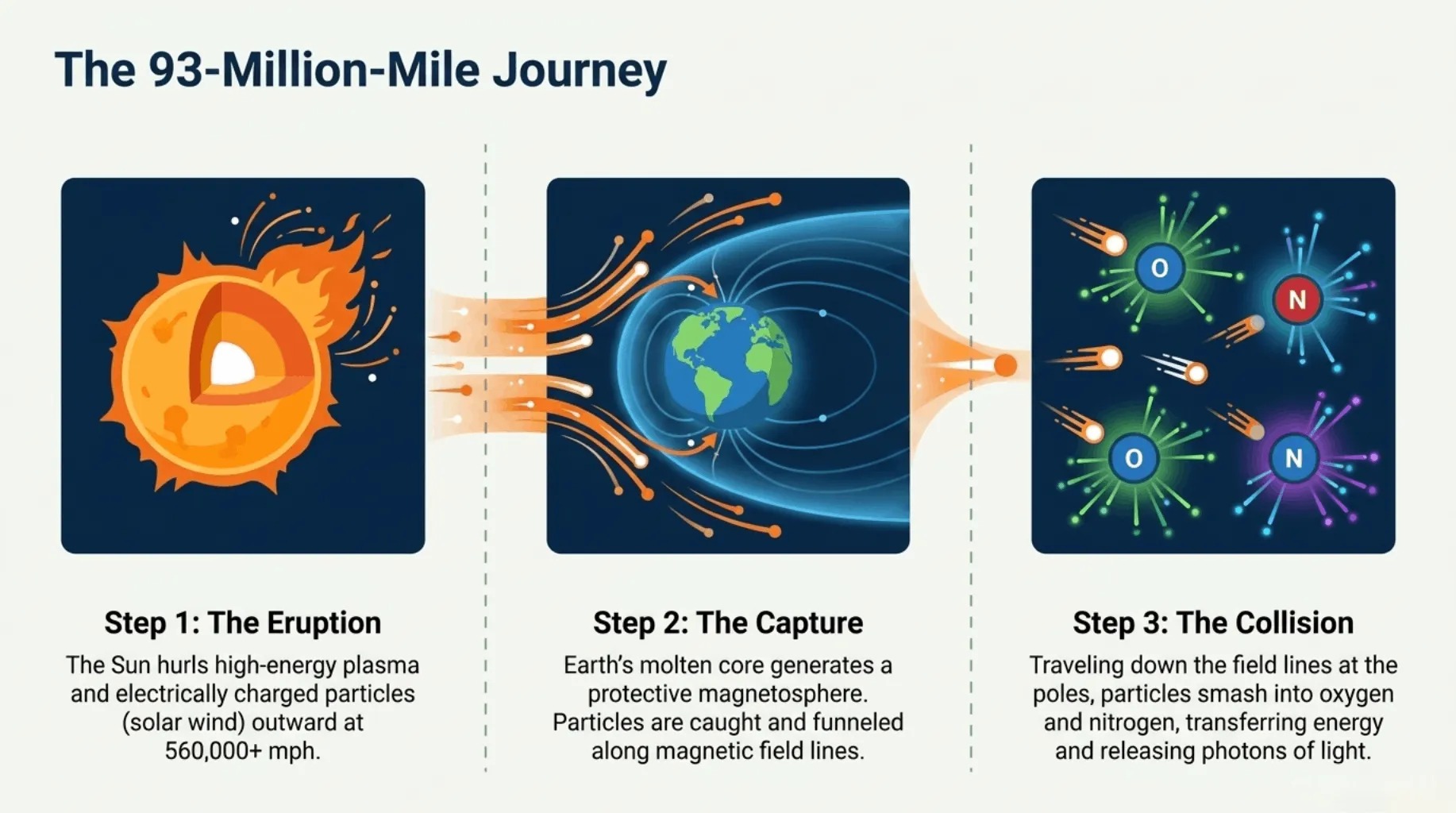
The aurora borealis is the visible end of a chain of events that begins 93 million miles away, on the surface of the Sun.
Step 1: The Sun Releases Charged Particles
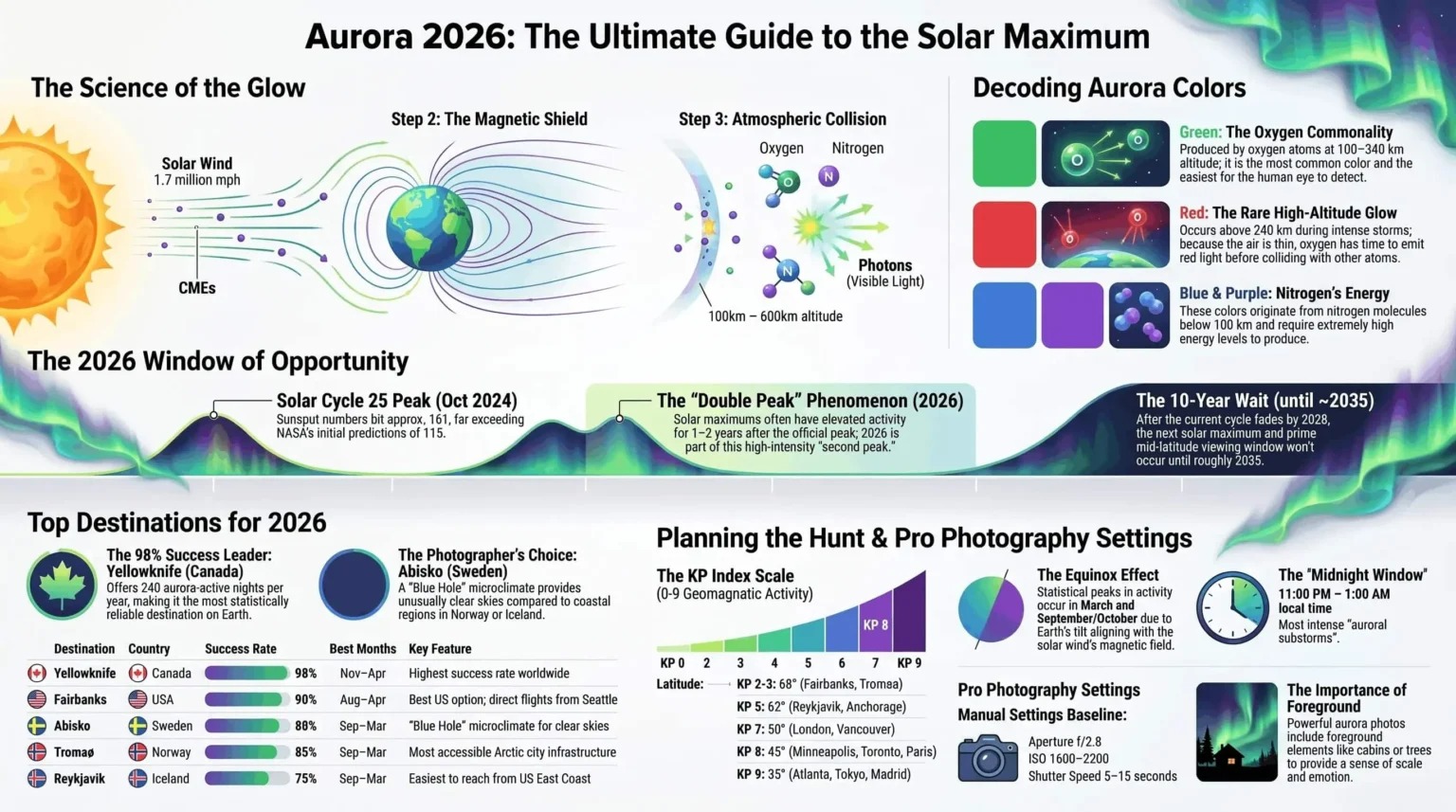
The Sun is constantly throwing off a stream of electrically charged particles — mostly electrons and protons — into space. This stream is called the solar wind, and it travels outward from the Sun in all directions at speeds between 250 and 750 kilometers per second (560,000 to 1.7 million miles per hour).
During quiet periods, the solar wind flows steadily and evenly. But the Sun is not a calm star. Its surface erupts regularly, producing two types of high-energy events:
- Solar flares — sudden bursts of electromagnetic radiation, classified from A (weakest) to X (strongest).
- Coronal mass ejections (CMEs) — massive bubbles of plasma and magnetic field, sometimes containing billions of tons of charged particles, hurled into space at high speed.
When a strong CME erupts in the direction of Earth, it dramatically increases the density and speed of the solar wind reaching our planet. That is when the conditions for spectacular auroras begin to align.
Step 2: Earth’s Magnetic Field Catches Them
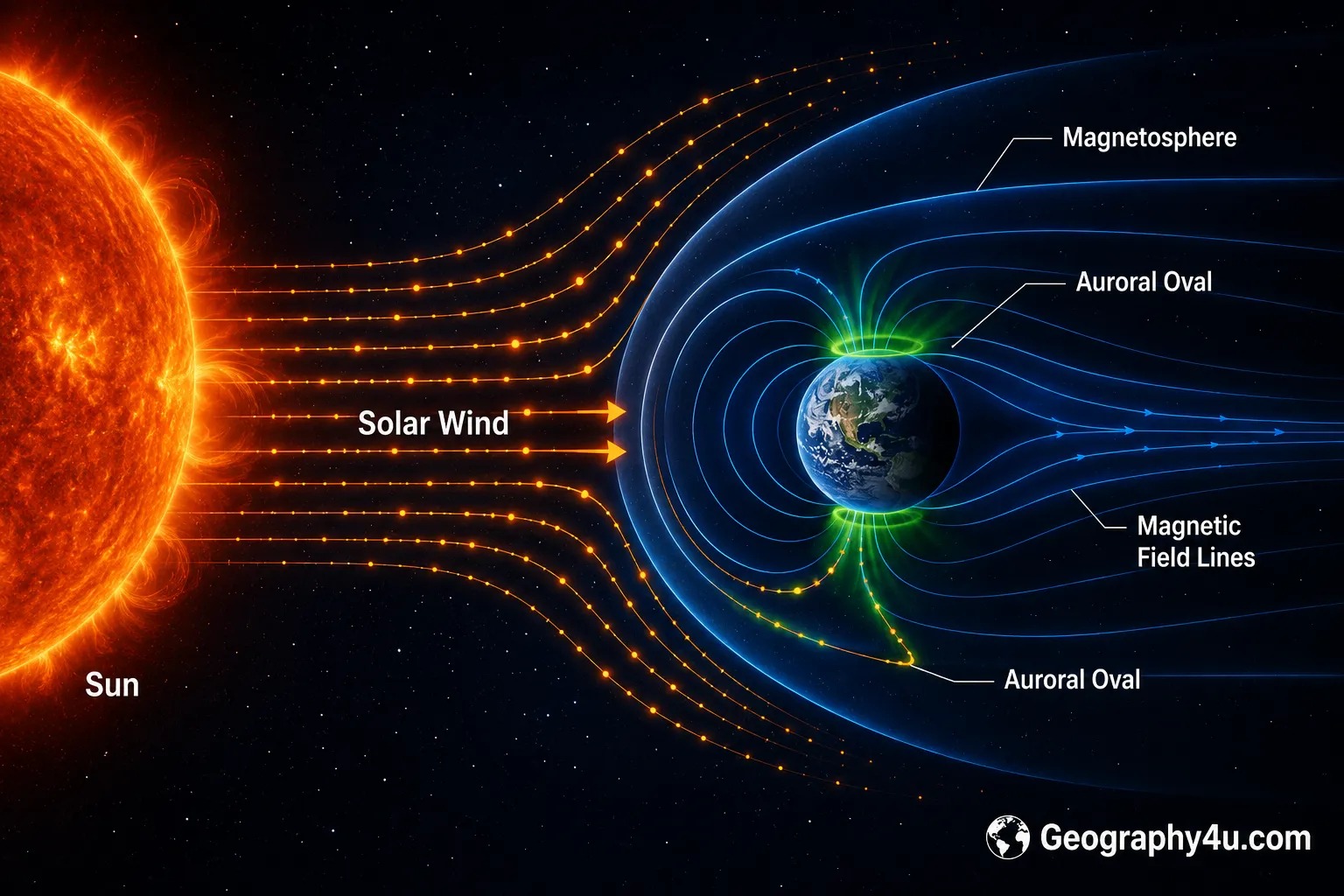
Earth has a powerful magnetic field generated by the movement of molten iron in its outer core. This field — called the magnetosphere — extends thousands of kilometers into space and acts as a protective shield, deflecting most of the solar wind around our planet.
However, the magnetosphere is not a perfect bubble. At the magnetic north and south poles, the magnetic field lines curve down toward Earth’s surface. Charged particles from the solar wind get caught by these field lines and funneled into the upper atmosphere near the poles, in regions known as the auroral ovals.
Step 3: Particles Collide With Atmospheric Gases
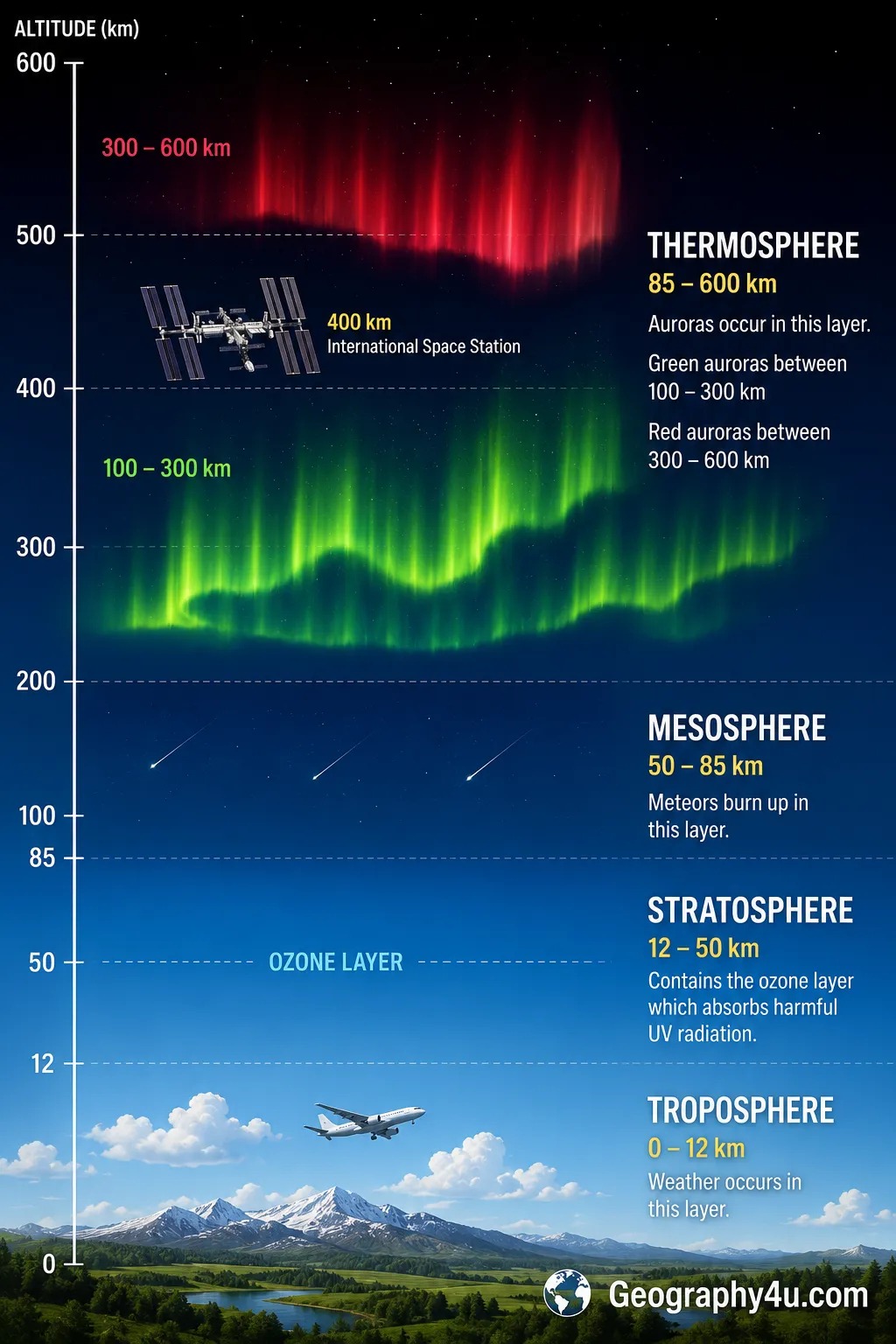
When solar particles travel down the magnetic field lines and hit Earth’s upper atmosphere — between roughly 100 and 600 kilometers (60 to 370 miles) altitude — they collide with atoms and molecules of oxygen and nitrogen.
Each collision transfers energy from the solar particle to the atmospheric gas. The gas atom enters an “excited” state, then quickly returns to its normal state by releasing the extra energy as a photon — a particle of light. Multiply this process by trillions of collisions per second across hundreds of square kilometers of sky, and you get the shimmering, dancing display we call the aurora borealis.
The strength of the aurora depends on three variables: the speed of the solar wind, the density of charged particles, and — most importantly — the orientation of the solar wind’s magnetic field. When the solar wind’s magnetic field points southward (opposite to Earth’s), the two fields connect and energy transfers efficiently into the magnetosphere. That is when the strongest auroras occur.
Related read: How Earth’s Molten Core Creates the Magnetic Field That Protects Us
Why Auroras Are Green, Red, Pink, and Purple
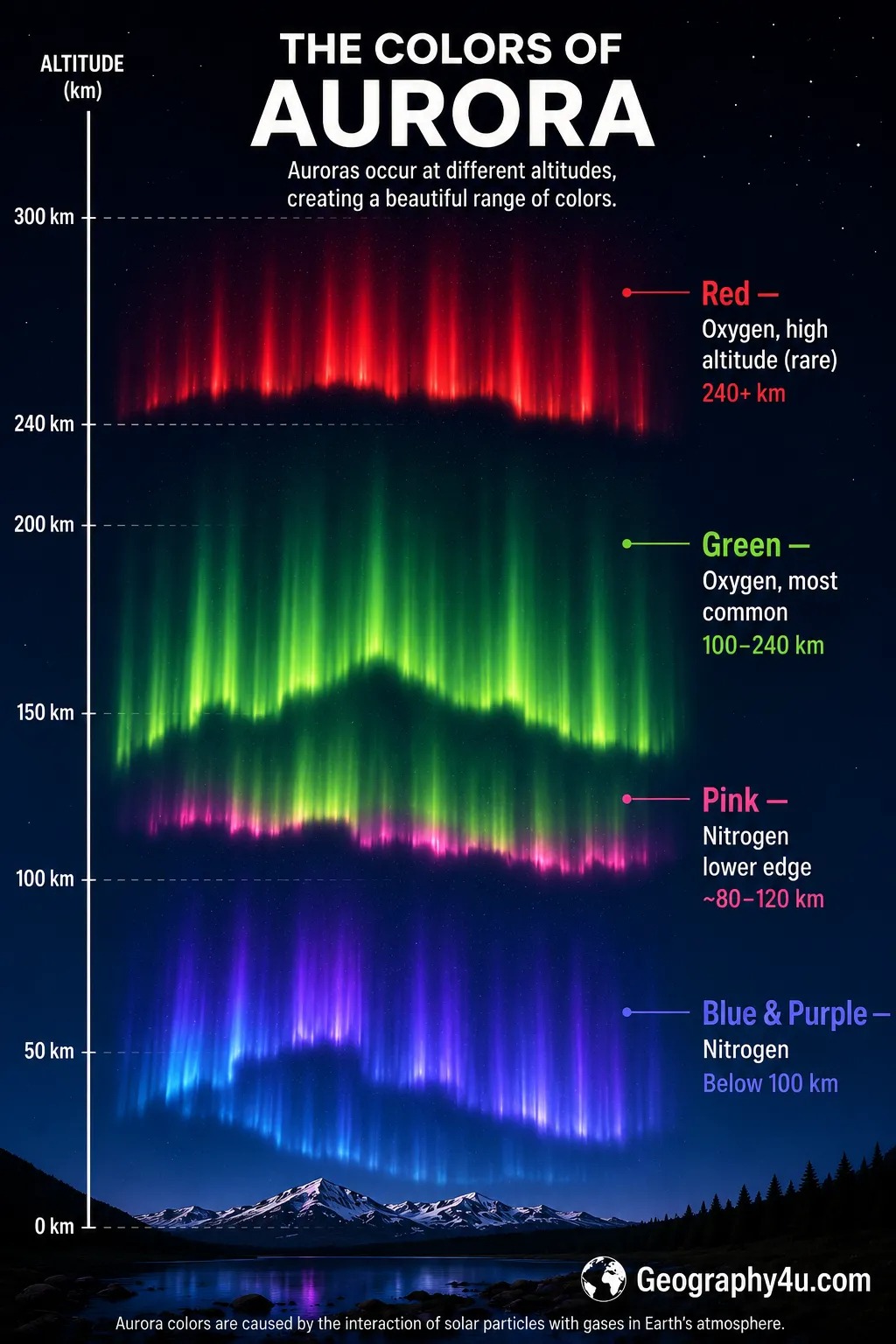
The colors of the aurora are not random. Each color corresponds to a specific gas being excited at a specific altitude — a code that, once decoded, lets you read the sky like a chemistry textbook.
Green — The Most Common Aurora Color
About 90 percent of all auroras you will ever see are green. Green light is produced when energetic particles excite oxygen atoms at altitudes between 100 and 240 kilometers. The specific wavelength is 557.7 nanometers, and it happens to be one of the brightest colors the human eye can detect. Green is also the color most commonly captured in photographs.
Red — The Rare High-Altitude Glow
Red auroras are produced by oxygen atoms much higher in the atmosphere — above 240 kilometers, sometimes reaching 400 km. At these altitudes the air is so thin that excited oxygen atoms have time to release red light at 630.0 nanometers before colliding with anything else. Red auroras typically appear during very strong geomagnetic storms and are often visible at lower latitudes than green aurora — which is why the May 2024 storm produced reddish skies as far south as Texas and Mexico.
Blue and Purple — Nitrogen at Low Altitudes
Blue and purple colors come from nitrogen molecules below 100 km altitude. These wavelengths require a lot of energy to produce, so they typically only appear during intense geomagnetic activity. Blue is rarer than purple, and both colors usually appear as the lower fringe of an otherwise green aurora.
Pink and Crimson — The Border Effect
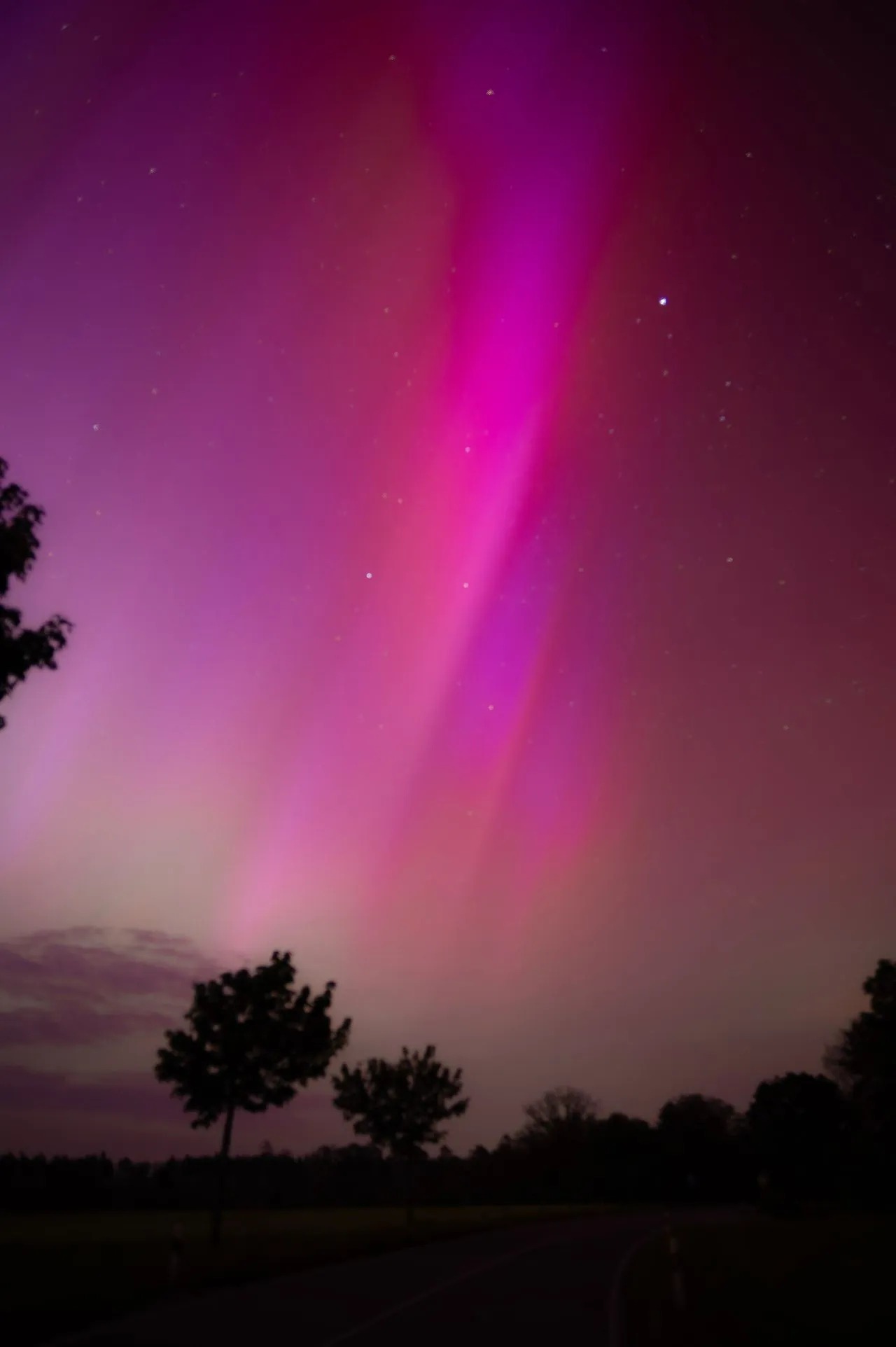
The pink and crimson edges sometimes seen at the bottom of green aurora curtains are caused by nitrogen at the boundary between the oxygen-dominated upper layer and the nitrogen-rich lower atmosphere. This pinkish band is one of the most photographed and most beautiful features of any strong aurora display.
The 2024-2026 Solar Maximum: Why Now Is the Best Time in 11 Years
Most articles on the northern lights treat solar activity as background information. They shouldn’t. Solar activity is the single most important factor determining whether you will actually see the aurora during your trip — and right now, in 2026, we are living through a once-in-a-decade window that almost no one outside the space weather community fully understands.
The 11-Year Solar Cycle
The Sun’s activity follows a cycle of approximately 11 years, alternating between periods of low activity (solar minimum) and high activity (solar maximum). During solar maximum, the Sun produces dramatically more sunspots, solar flares, and coronal mass ejections — all of which feed the conditions that create strong auroras on Earth.
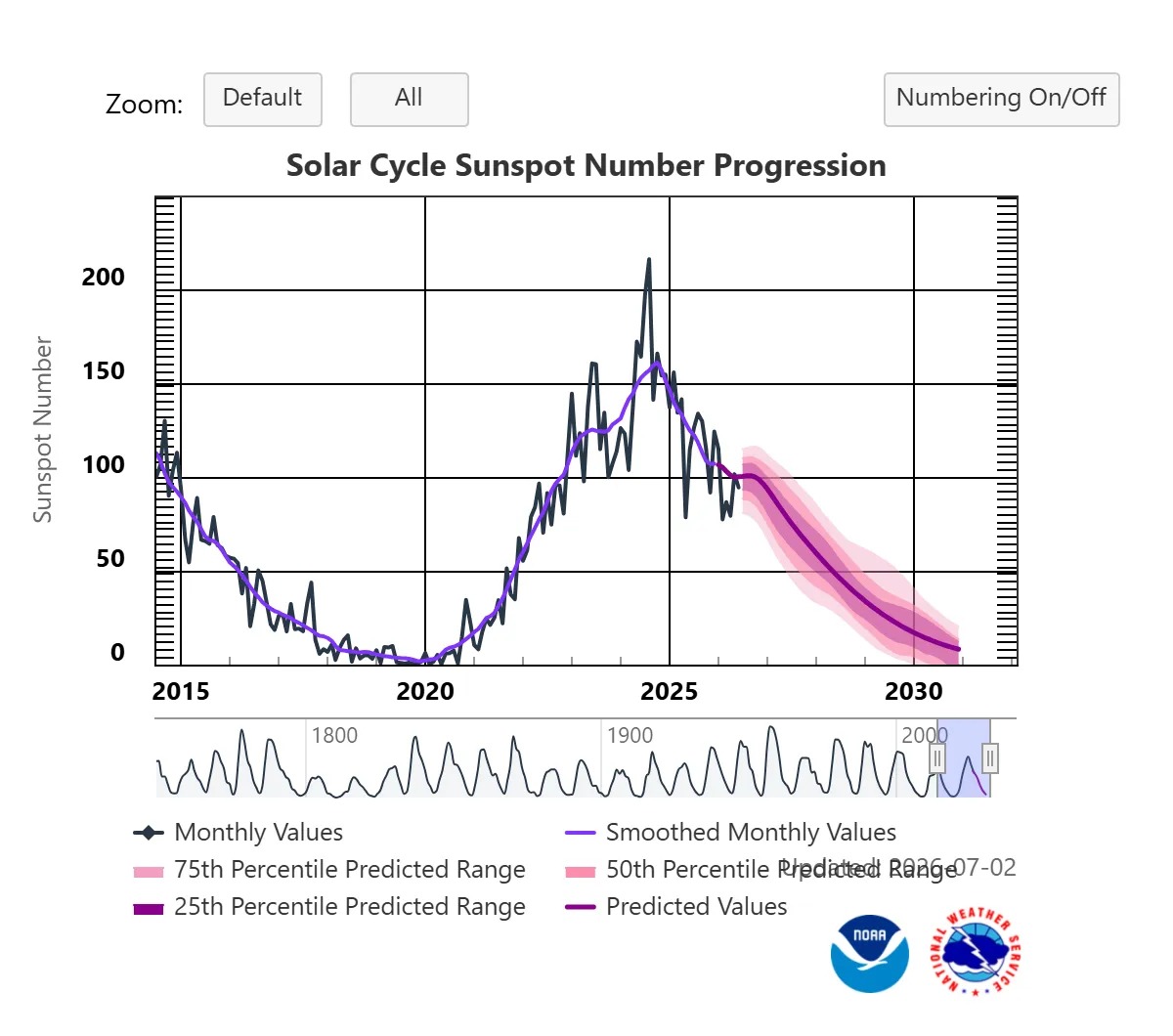
According to NASA’s official tracking, Solar Cycle 25 — the 25th cycle since systematic recording began in 1755 — reached its solar maximum in October 2024, with a smoothed sunspot number of approximately 161. That figure is far higher than the 115 that NASA originally predicted, and it puts Cycle 25 close to the strength of Cycle 23 in the early 2000s.
The Double-Peak Phenomenon
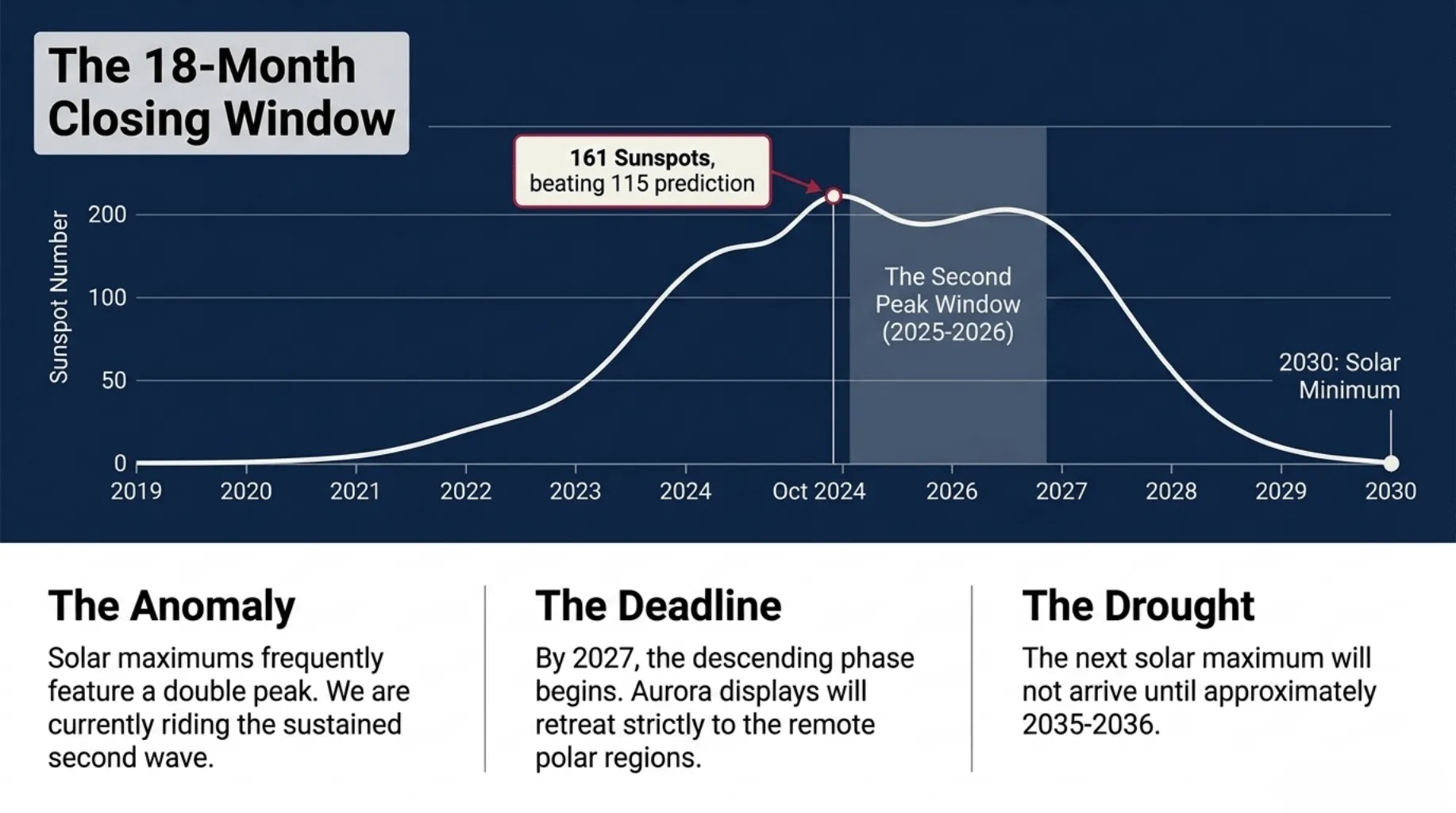
Here is what most travel guides miss: solar maximums are usually not single peaks. They tend to have a “double peak” structure, with elevated activity continuing for 1 to 2 years after the official maximum. Cycle 25 has followed this pattern almost perfectly:
- First peak (late 2023 to mid-2024): Delivered the May 2024 G5 Gannon Storm and over 50 X-class solar flares.
- Second peak (late 2025 into 2026): Continued high activity, with the X5.1-class flare of November 11, 2025 marking the strongest event of the year.
- Descending phase (2026-2028): Sunspot numbers gradually decline, but major storms can still occur — sometimes the largest storms of an entire cycle appear 1 to 2 years after sunspot peak.
Why This Matters for You in 2026
The next solar maximum is not expected until approximately 2035-2036 — roughly a decade away. After Cycle 25 fades, aurora activity will gradually retreat toward the polar regions. The window for relatively easy aurora viewing at mid-latitudes that we are currently in will close, and it will not reopen for at least 10 years.
If you have never seen the aurora and want to, the next 24 months are your best chance until 2035.
Practically, this means a person at 45 degrees latitude or higher — which includes residents of Minnesota, Wisconsin, Michigan, Maine, Washington State, the entire United Kingdom, southern Canada, and most of northern Europe — has multiple realistic opportunities to see aurora from home in 2026 without traveling to the Arctic. And travelers who do venture north to dedicated aurora destinations are now seeing displays that were not possible during the previous decade’s weak Solar Cycle 24.
Where to See the Northern Lights in 2026
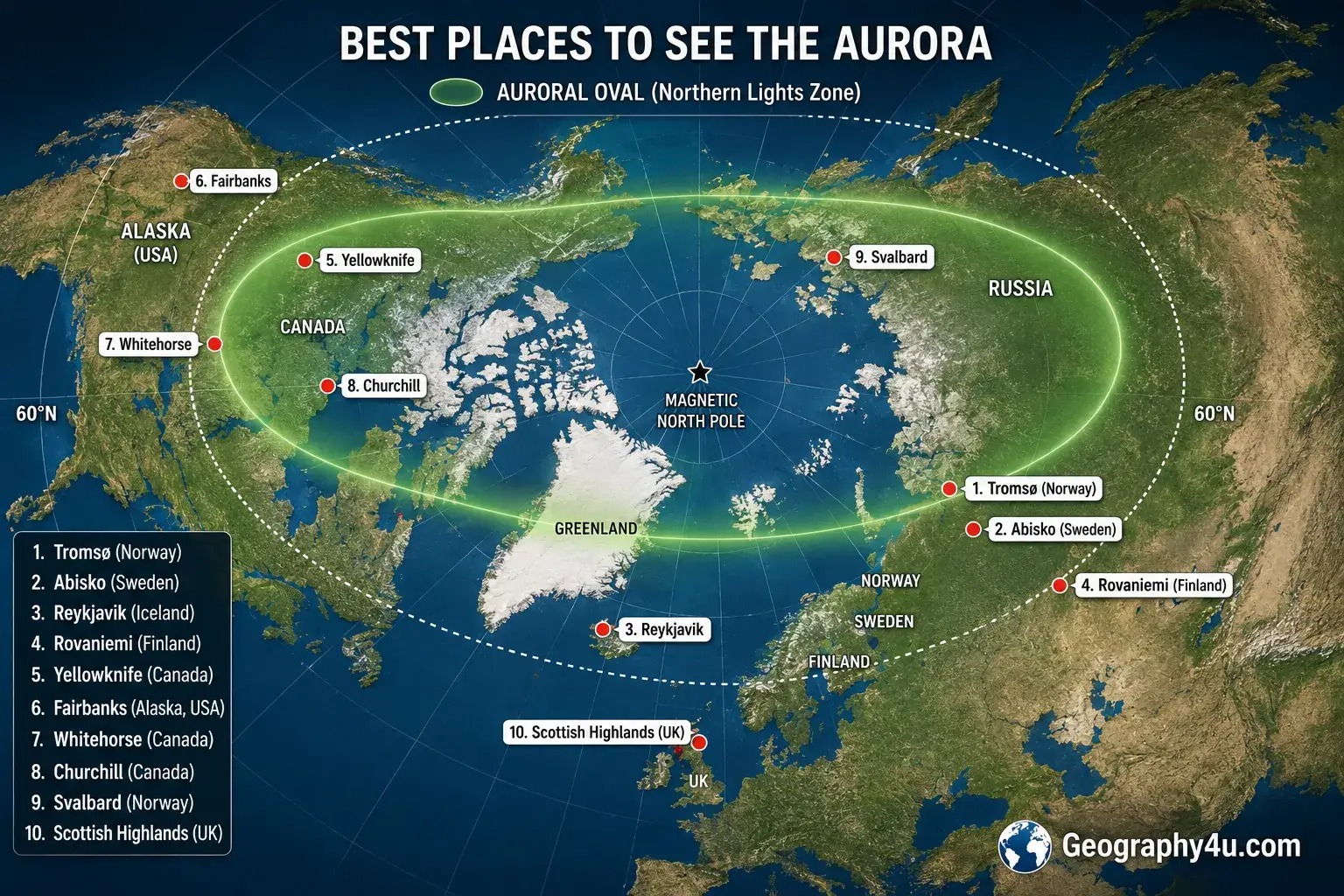
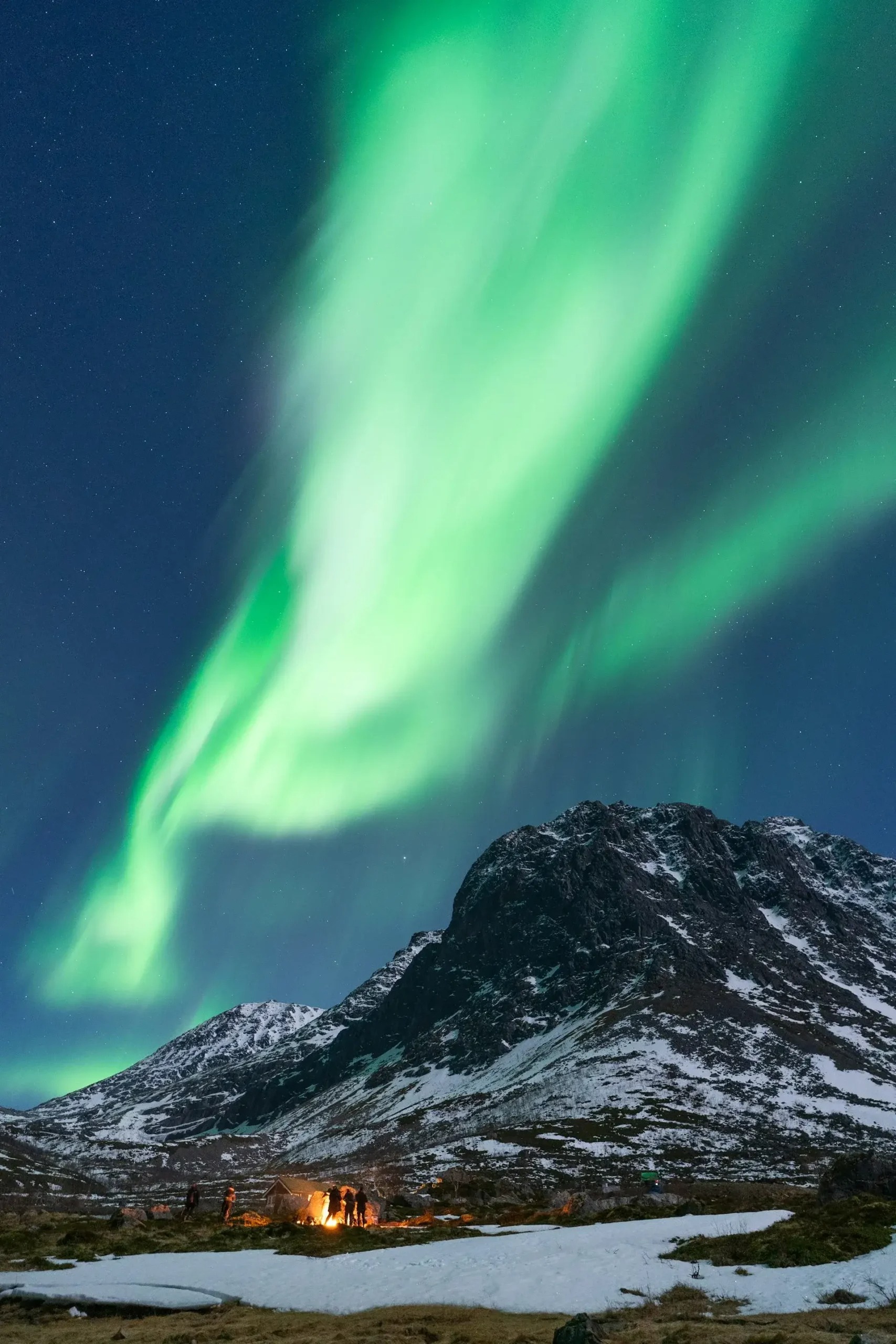
The single most important factor in planning an aurora trip is location — specifically, how close you are to the auroral oval, the band of intense aurora activity that wraps around the magnetic north pole roughly between 60 and 75 degrees magnetic latitude. The closer you are to the oval, the more often you will see aurora and the brighter it will be when it appears.
The destinations below are ranked by a combination of three factors: success rate (chance of seeing aurora during a 3-night stay), accessibility from major Western cities, and quality of the surrounding experience.
Top 10 Aurora Destinations for 2026
| Destination | Country | Success Rate (3 nights) | Best Months | Why Go |
|---|---|---|---|---|
| Yellowknife | Canada (NWT) | 98% | Nov–Apr | Highest success rate worldwide. 240 aurora-active nights/year. |
| Tromsø | Norway | 85% | Sep–Mar | Most accessible Arctic city. Direct flights from Oslo, London. |
| Abisko | Sweden | 88% | Sep–Mar | “Blue Hole” microclimate gives unusually clear skies. |
| Fairbanks | USA (Alaska) | 90% | Aug–Apr | Best US option. Direct from Seattle. Chena Hot Springs nearby. |
| Reykjavik | Iceland | 75% | Sep–Mar | Easiest from US East Coast. Combine with Golden Circle. |
| Rovaniemi | Finland | 80% | Sep–Mar | Glass igloos. Family-friendly. Santa’s Village. |
| Whitehorse | Canada (Yukon) | 88% | Aug–Apr | Cheaper than Yellowknife. Hot springs, wildlife. |
| Churchill | Canada (MB) | 95% | Jan–Mar | Aurora + polar bears + belugas. Unique combo. |
| Svalbard | Norway | 85% | Nov–Feb | Northernmost civilian destination. Polar night. |
| Scottish Highlands | UK | 25% | Oct–Mar | UK’s best aurora option during major storms. |
The Best Choice for Each Type of Traveler
For Americans on a tight budget: Fairbanks, Alaska. It is the only US destination with a serious chance of seeing aurora, and direct flights from Seattle keep travel costs down.
For first-time aurora travelers: Tromsø, Norway. The combination of accessibility, infrastructure, English-speaking guides, and 85% success rate makes it the lowest-stress option.
For photography enthusiasts: Abisko, Sweden. The “Blue Hole” microclimate created by surrounding mountains keeps skies clearer than coastal Norway or Iceland, making it the destination of choice for serious aurora photographers.
For maximum chance of success: Yellowknife, Canada. With a 98% success rate over a 3-night stay, it is statistically the most reliable aurora destination on Earth.
For the trip-of-a-lifetime experience: Churchill, Manitoba. Where else can you see polar bears in autumn, belugas in summer, and aurora borealis over a frozen tundra in winter, all in the same town?
Related read: What is longitude and latitude on a map?
Best Time of Year, Night, and Moon Phase
Choosing the right destination is half the battle. The other half is timing — and timing the aurora has three layers: the right month, the right time of night, and the right moon phase.
The Best Months
The aurora is technically present year-round, but you cannot see it during summer at high latitudes because of the midnight sun — there are no dark hours during which the lights become visible. The viewing season runs from late August through early April, but not all months within this window are equal:
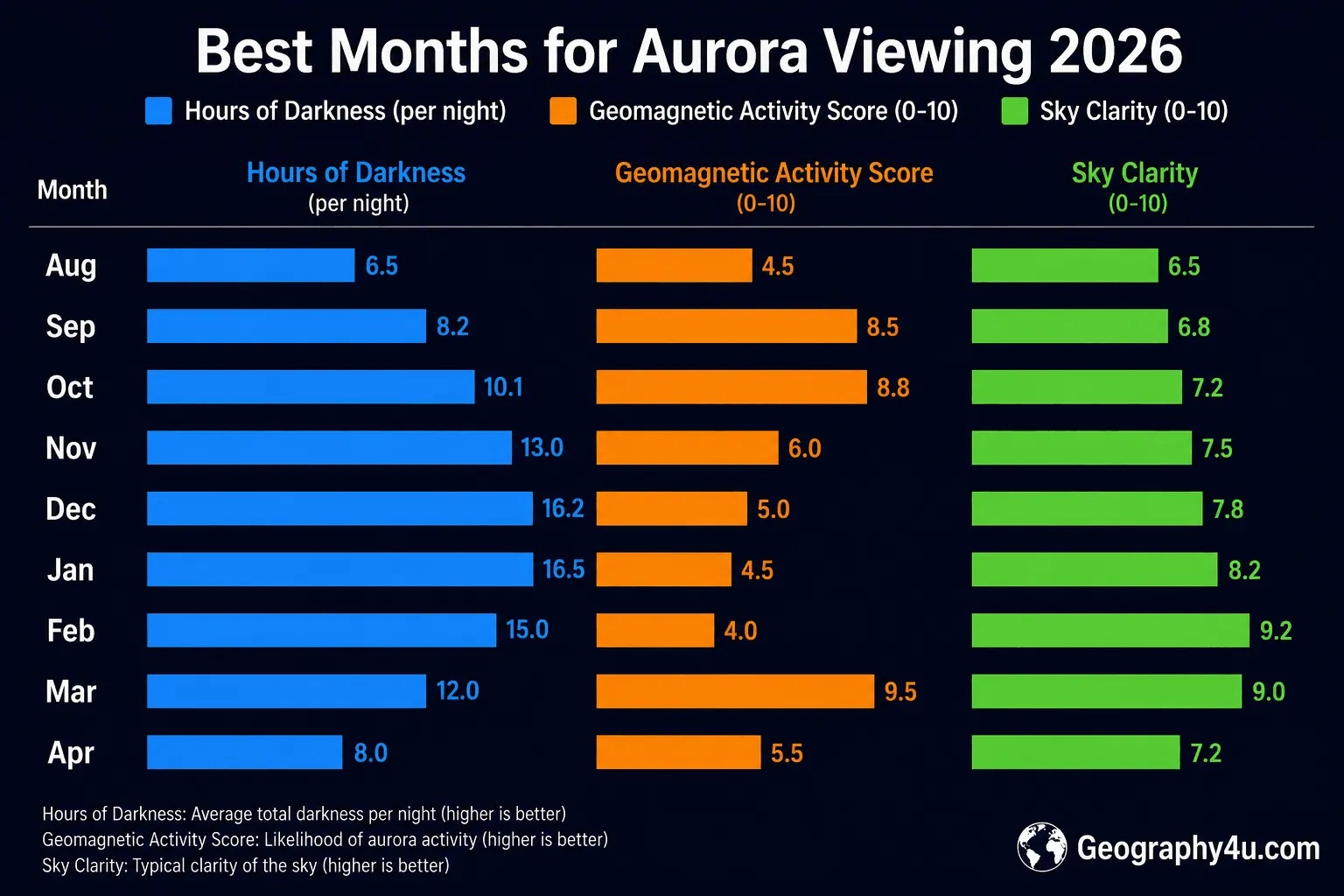
- March and September-October are statistically the best months. Geomagnetic activity peaks around the spring and fall equinoxes due to a phenomenon called the Russell-McPherron effect, in which Earth’s tilt aligns favorably with the solar wind’s magnetic field.
- December-February offer the longest dark nights and the most dramatic snowy landscapes for photography, but typically more cloud cover and colder temperatures (often -30°C or below in places like Yellowknife and Fairbanks).
- Late August and early April are the shoulder months — milder temperatures but shorter dark windows.
The Best Hours
Aurora typically becomes visible after the sky darkens fully. Across the Arctic Circle, this means displays usually start around 9:00-10:00 PM local time, peak around midnight to 2:00 AM, and fade by 3:00-4:00 AM. The most intense bursts of activity, called auroral substorms, almost always happen between 11 PM and 1 AM local time. Plan to be outside, in position, and ready by 10 PM at the latest.
The Moon Phase
This is the variable most travelers ignore — and it is the one that most dramatically affects photo quality. A full moon throws enough light to wash out faint auroras, especially in photographs. Plan your trip during a new moon or crescent moon phase. Check NASA’s lunar calendar before booking and aim for arrival within 3 days of the new moon.
The KP Index Cheat Sheet
The KP index measures global geomagnetic activity on a scale of 0 to 9. The higher the number, the further south the aurora is visible. Use this as a guideline:
| KP Value | Aurora Visible Down To | Example Cities |
|---|---|---|
| KP 2-3 | 68° latitude | Fairbanks, Tromsø, Yellowknife |
| KP 4-5 | 62° latitude | Reykjavik, Anchorage, Whitehorse |
| KP 6 | 55° latitude | Edinburgh, Edmonton, Stockholm |
| KP 7 | 50° latitude | London, Vancouver, Berlin, Seattle |
| KP 8 | 45° latitude | Minneapolis, Toronto, Paris |
| KP 9 | 35° latitude | Atlanta, Tokyo, Madrid (rare) |
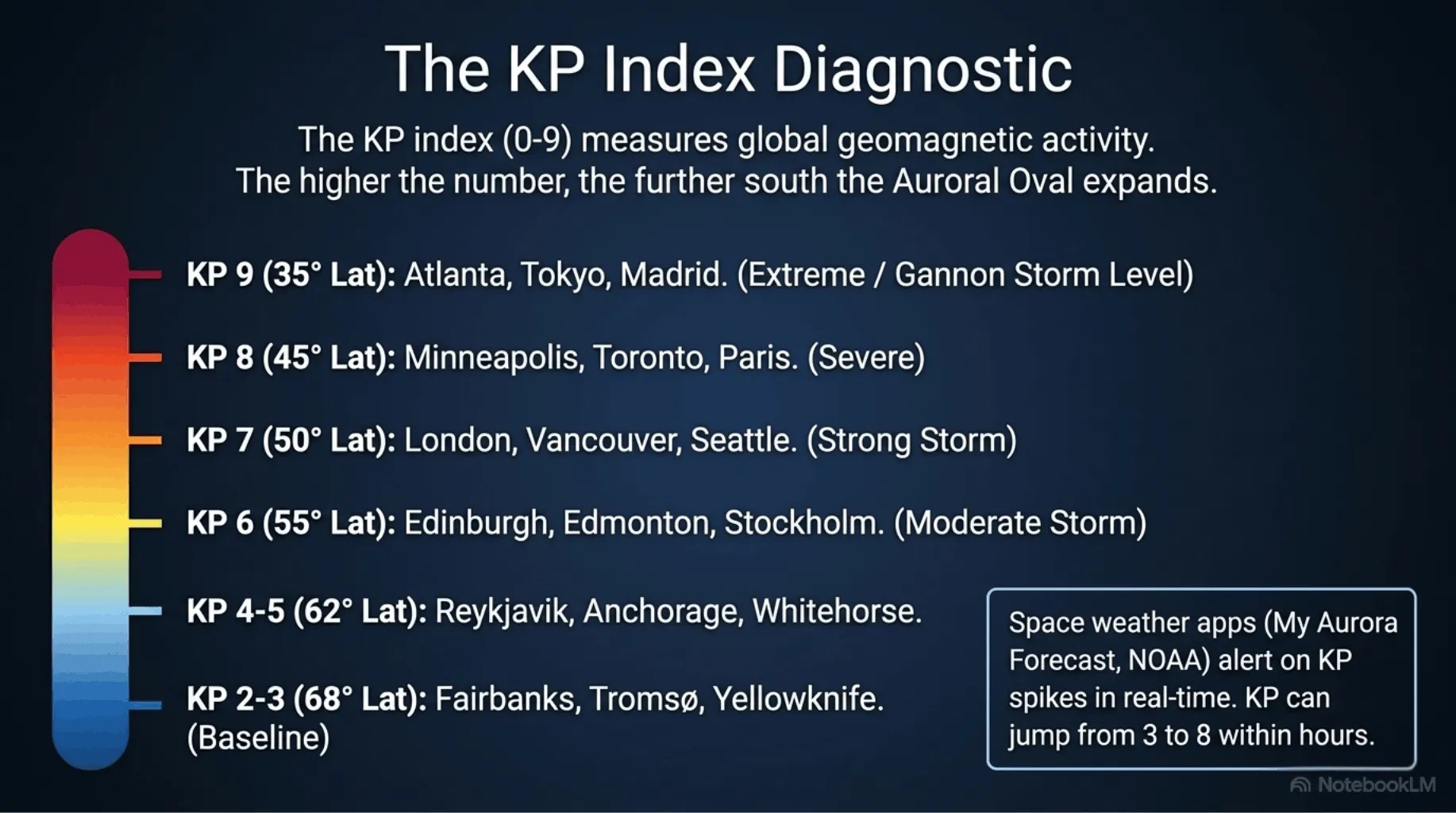
Apps like My Aurora Forecast, Hello Aurora, and the official NOAA Space Weather Dashboard let you set custom alerts for your location. During a strong storm, KP can jump from 3 to 8 within hours — having alerts on your phone is the difference between catching the aurora and reading about it the next morning.
The Southern Lights: Aurora Australis Explained
Every aurora borealis in the Northern Hemisphere has a mirror twin in the Southern Hemisphere — the aurora australis, or southern lights. The two phenomena are produced by the same physical process and often happen simultaneously, but the southern lights are far less famous because almost no one lives near them.
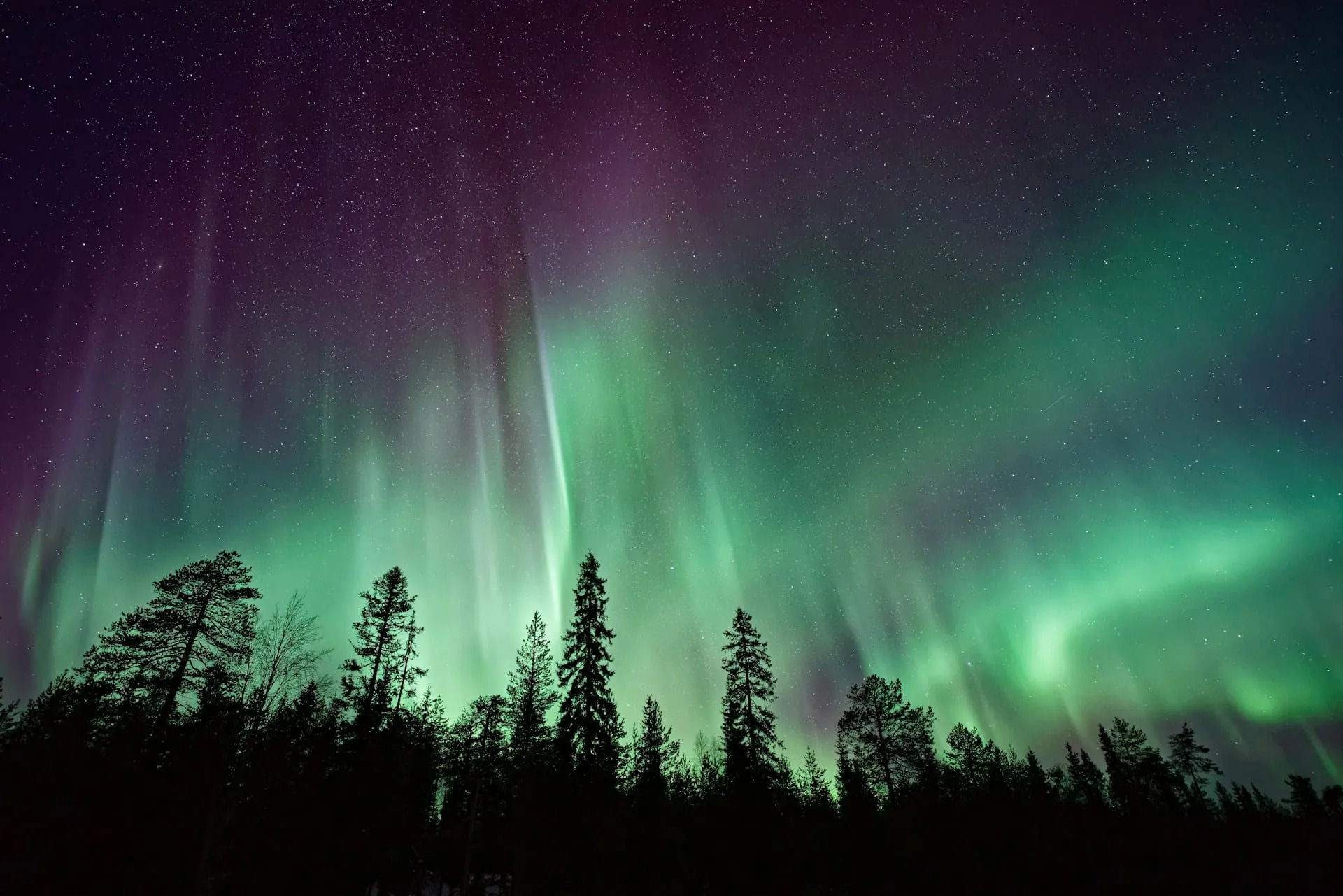
The Antarctic auroral oval falls almost entirely over open ocean and the uninhabited Antarctic continent. The few accessible Southern Hemisphere viewing locations are:
- Tasmania, Australia — the most reliable southern aurora destination, particularly the south coast around Hobart and Bruny Island.
- South Island, New Zealand — Stewart Island, Lake Tekapo Dark Sky Reserve, and Dunedin are all good options.
- Southern Argentina and Chile — Tierra del Fuego occasionally sees aurora during strong storms.
- Antarctica — visible year-round to research station personnel, but inaccessible to most travelers.
During the May 2024 G5 Gannon Storm, aurora australis was reported as far north as Perth, Western Australia and the southern coast of Argentina — sightings that had not occurred in over 20 years. If you live in Australia or New Zealand, the 2024-2026 solar maximum is your best chance to see the southern lights from your home country in a generation.
Aurora Mythology Around the World
Long before scientists understood the aurora, every culture that lived under it had a story to explain it. These stories are some of the most beautiful in human folklore.
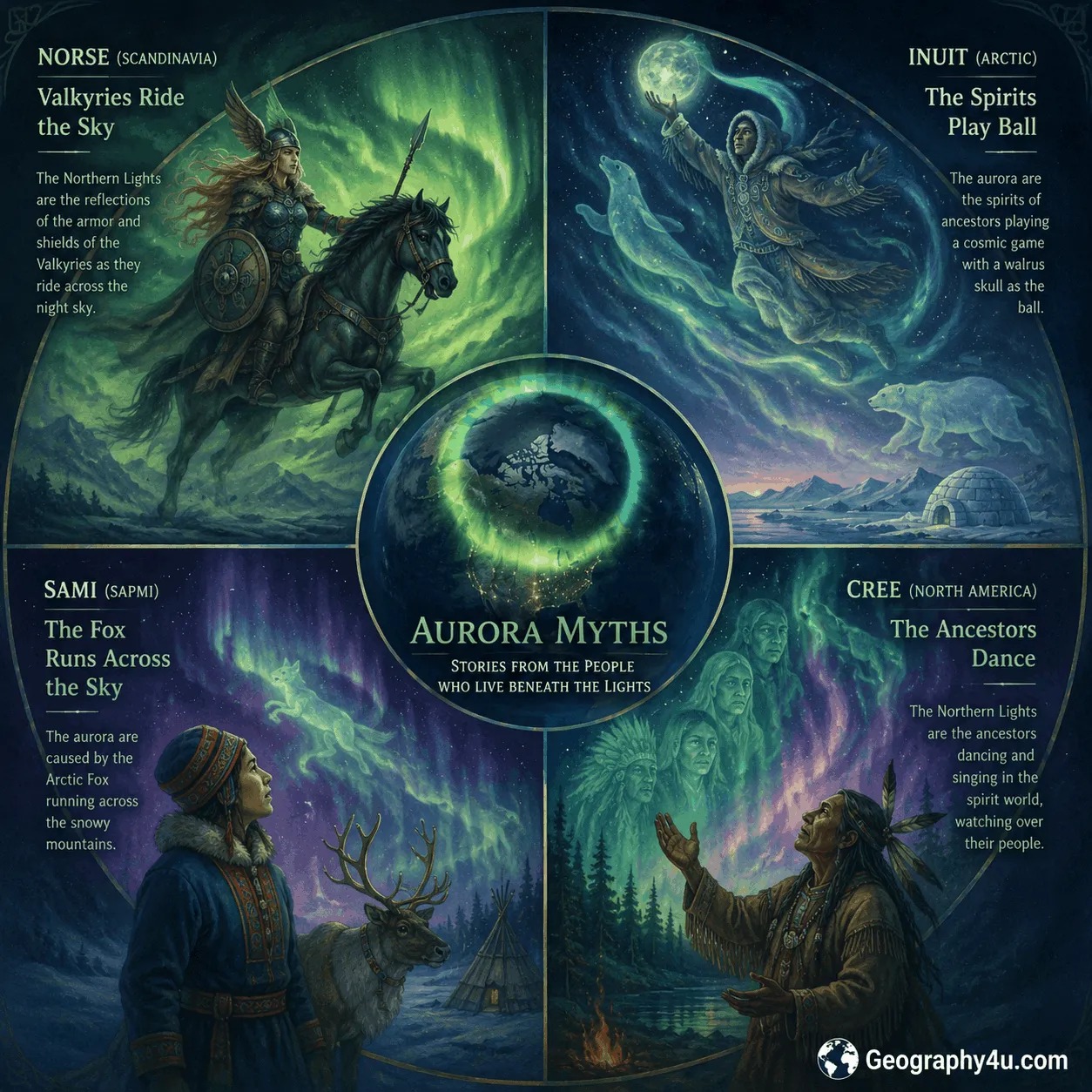
The Sami people of northern Scandinavia historically viewed the aurora with caution and reverence. Some Sami groups believed the lights were the souls of the deceased, and that whistling or singing under the aurora could attract their attention — bringing either guidance or harm. Even today, many Sami consider it disrespectful to point at the lights.
The Inuit and Cree of North America told their children that the aurora was the spirits of their ancestors, playing a celestial ball game using a walrus skull as the ball. The Cree word for aurora translates roughly to “the dance of the spirits.” In some traditions, you could call the lights closer by whistling softly.
Norse mythology identified the aurora with the Bifröst Bridge, the rainbow path connecting the realm of mortals to the realm of the gods. Other Norse tales described the lights as reflections from the armor of the Valkyries — the winged maidens who carried slain warriors to Valhalla.
Finnish folklore attributed the aurora to a magical fox running across the snowy hills, its tail brushing the sky and sending sparks into the heavens. The Finnish word for aurora — revontulet — literally means “fox fires.”
In Japanese folklore, conceiving a child under the aurora is said to bring good fortune to the family. This belief, combined with Japan’s high disposable income and proximity to aurora-viewing destinations like Yellowknife and Fairbanks, has made Japanese tourism one of the largest segments of the global aurora travel industry.
How to Photograph the Aurora
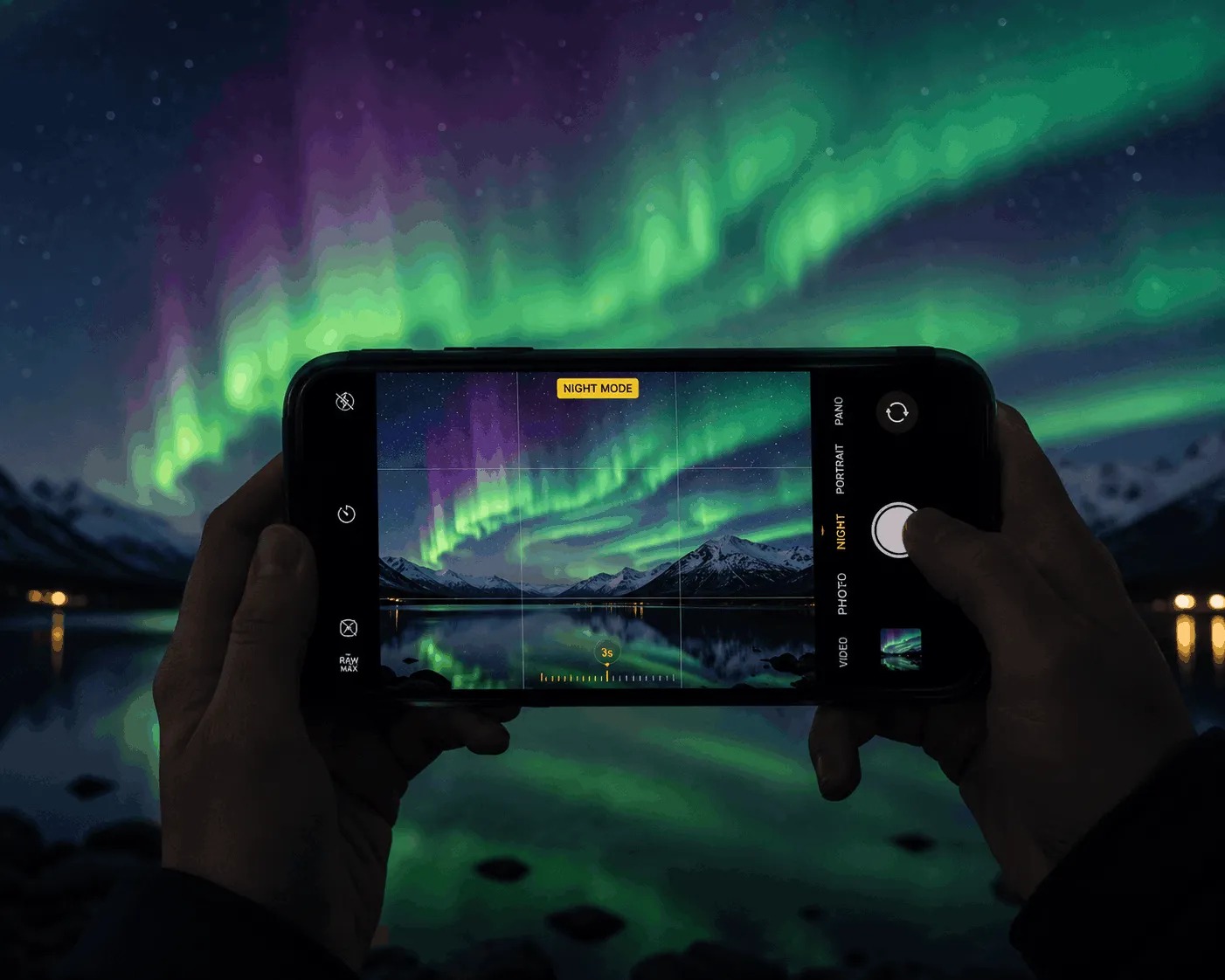
Modern smartphones can now capture aurora in a way that was impossible just five years ago. But to get truly stunning images, you still need a few key pieces of gear and a basic understanding of long-exposure photography.
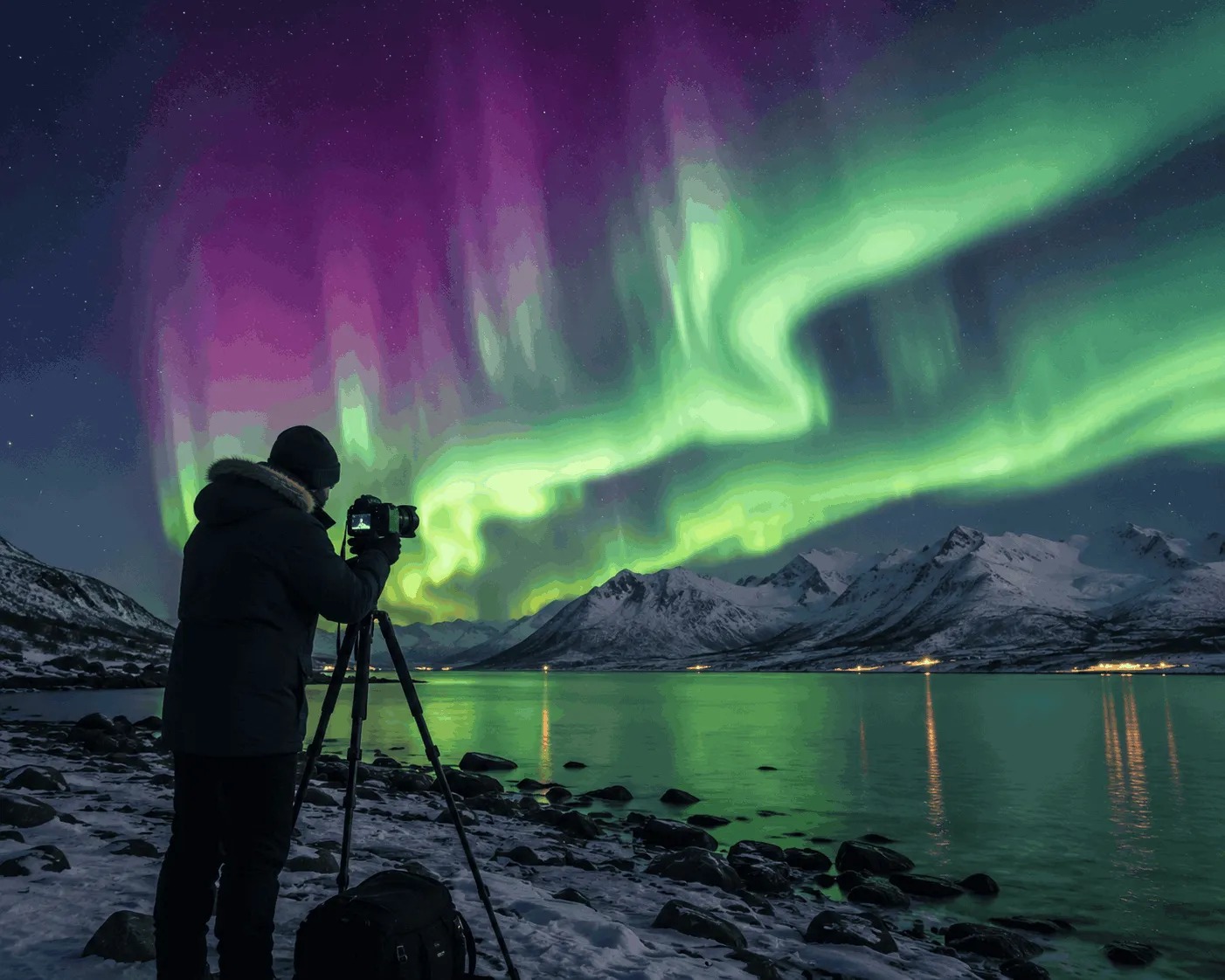
Camera Gear Checklist
- Camera with manual mode — A DSLR or mirrorless camera with a full-frame or APS-C sensor performs best. Modern flagship smartphones (iPhone 15 Pro, Pixel 8 Pro and later) have dedicated Night Mode that produces remarkably good aurora shots.
- Wide-angle lens — Look for f/2.8 or wider aperture. A 14-24mm lens is ideal.
- Sturdy tripod — Non-negotiable. Long exposures require zero camera shake. Bring a model rated for cold weather.
- Remote shutter or 2-second timer — Pressing the shutter manually introduces shake.
- Spare batteries kept warm in inner pockets — Cold drains lithium batteries within minutes.
- Lens hand warmers — Adhesive chemical hand warmers stuck to the lens prevent fogging at -30°C.
Camera Settings (Starting Point)
| Setting | Recommended Value | Notes |
|---|---|---|
| Aperture | f/2.8 (or as wide as your lens allows) | Wider aperture = more light = shorter exposure needed. |
| ISO | 1600-3200 | Higher ISO for faint aurora, lower for bright. |
| Shutter Speed | 5-15 seconds | Faster shutter for fast-moving aurora, longer for faint. |
| Focus | Manual, set to infinity | Test focus on a bright star before aurora appears. |
| White Balance | 3500-4000K (or daylight) | Avoid auto white balance — it confuses the colors. |
| File Format | RAW | RAW preserves detail in shadows and highlights. |
Composition Tips
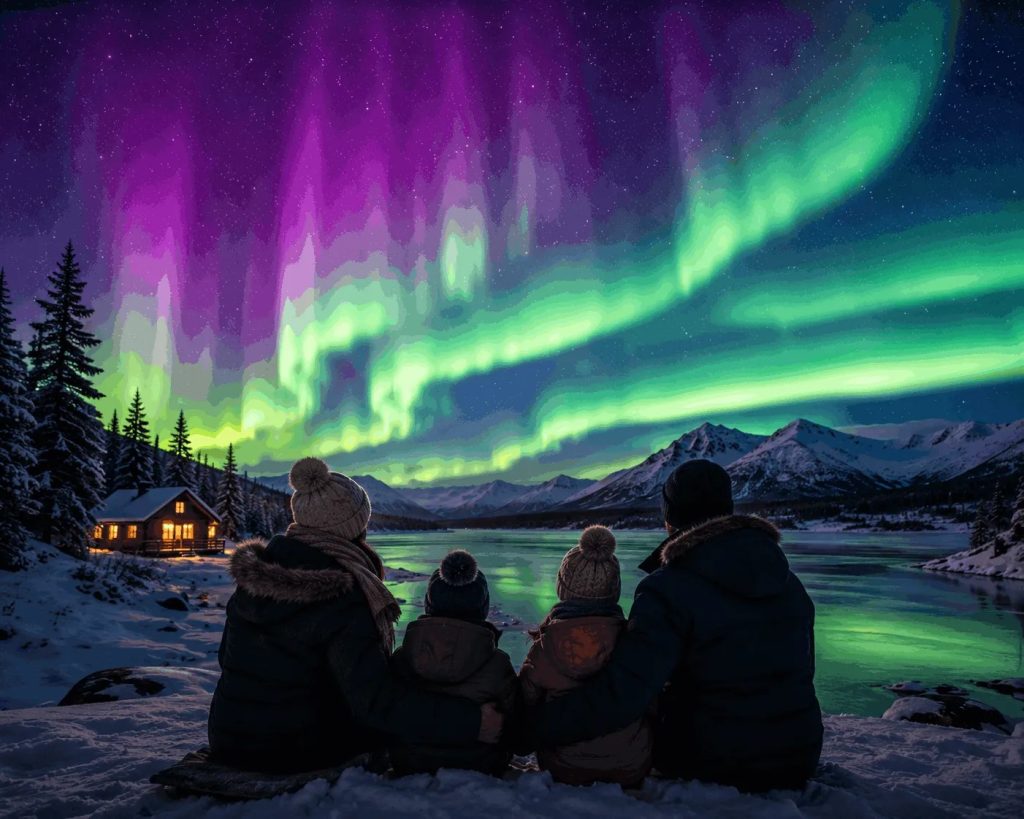
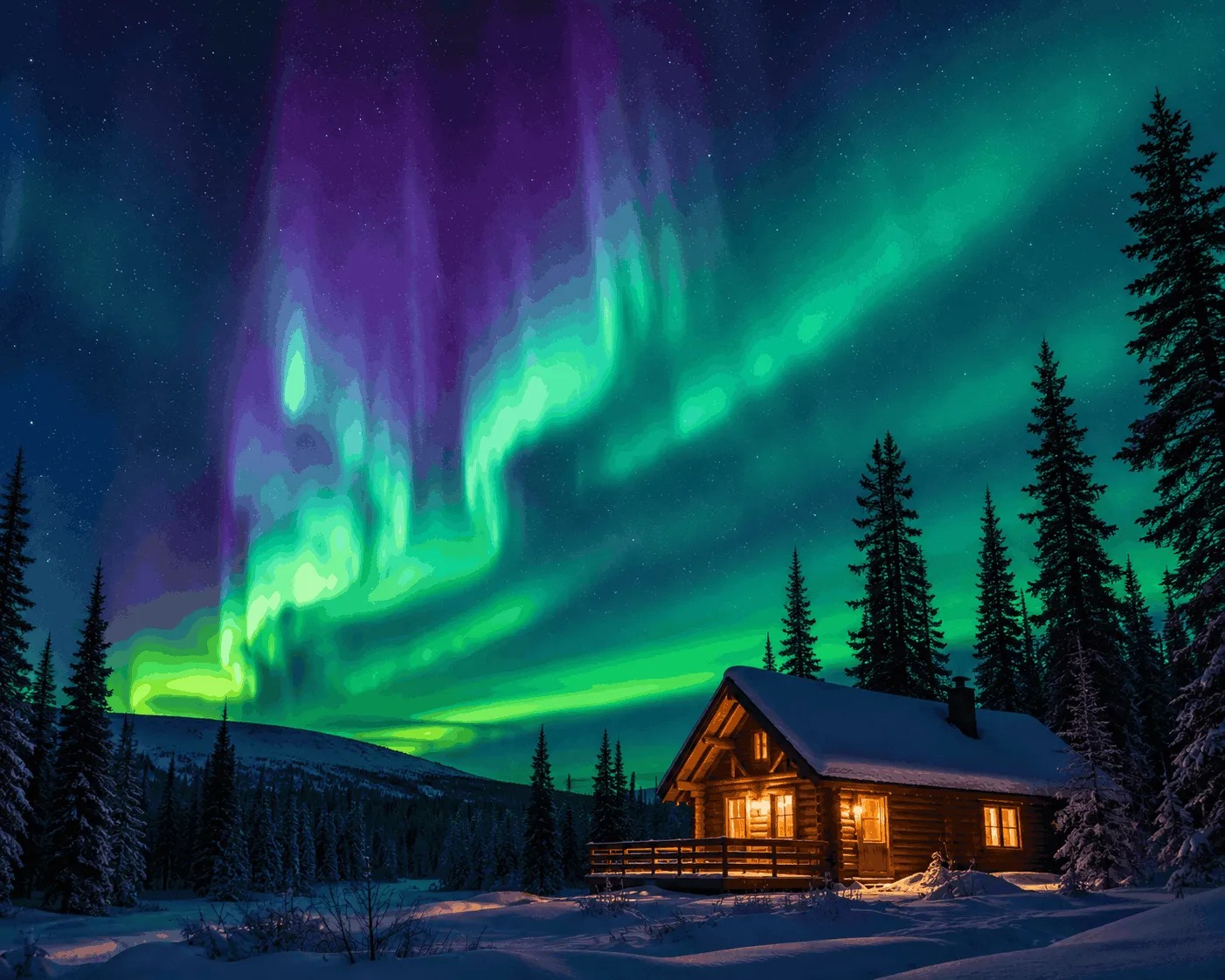
The biggest mistake new aurora photographers make is filling the frame with sky. The most powerful aurora photographs include a strong foreground element — a snow-covered cabin, a single tree, a frozen lake reflection, a silhouetted person looking up. The foreground gives the viewer a sense of scale and emotion that pure sky shots lack.
Frequently Asked Questions
Is 2026 still a good year to see the northern lights?
Yes. Although Solar Cycle 25 peaked in October 2024, geomagnetic storms often remain strong for 1 to 2 years after solar maximum. NOAA forecasts continued G3-G4 level storms through 2026, with mid-latitude aurora displays still possible. The next solar maximum is not expected until 2035-2036.
What is the best month to see the aurora borealis?
March and September-October are statistically the best months. Geomagnetic activity peaks around the spring and fall equinoxes due to Earth’s tilt relative to the solar wind. December through February offer the longest dark nights but less geomagnetic activity on average.
Where is the easiest place to see the northern lights for Americans?
Fairbanks, Alaska. It sits directly under the auroral oval, has a 90% success rate over a 3-night stay during aurora season, and is reachable on direct flights from Seattle and Anchorage. Yellowknife in Canada’s Northwest Territories has an even higher 98% success rate but requires a connecting flight.
Why are auroras green most of the time?
Green aurora is produced when solar particles excite oxygen atoms at altitudes between 100 and 240 km. Oxygen is abundant at this altitude, and the green wavelength (557.7 nanometers) is the brightest emission the human eye can detect, making green the most commonly visible aurora color.
Can I see the northern lights without going to the Arctic?
During strong geomagnetic storms, yes. The May 2024 Gannon Storm (G5) made the aurora visible as far south as Mexico, India, and Florida. During the 2024-2026 solar maximum window, mid-latitude residents in the northern US, UK, and southern Canada have a realistic chance of seeing aurora from home several times per year.
What KP index do I need to see the aurora?
It depends on your latitude. In Tromsø, Norway or Fairbanks, Alaska, KP 2-3 is sufficient. In northern US states (Minnesota, Maine, Washington), you need KP 6 or higher. To see aurora as far south as London, New York, or Chicago, you need KP 7 or above, which only occurs during major geomagnetic storms.
How long does an aurora display last?
Individual displays can last from a few minutes to several hours. A typical strong night will see multiple bursts of activity, separated by quieter periods. The most intense visible activity, called auroral substorms, usually peaks around midnight local time and may last 30 to 90 minutes per substorm.
Final Thoughts: Why You Should Plan Your Aurora Trip Now
The 2024-2026 solar maximum is the best aurora-viewing window in over a decade — and it is closing. By 2027, we will be deep into the descending phase of Solar Cycle 25. By 2029, aurora will have largely retreated to the polar regions. The next chance to see aurora the way millions saw it in May 2024 will not arrive until around 2035.
If you have ever wanted to see the northern lights in person, the practical answer is straightforward: plan a trip in the next 18 months. Pick a destination from the table above based on your budget and travel style. Aim for a 3-night minimum stay during March, September, or October. Book during a new moon. Download the My Aurora Forecast app. Pack a tripod.
And then — the most important part — go outside and look up.