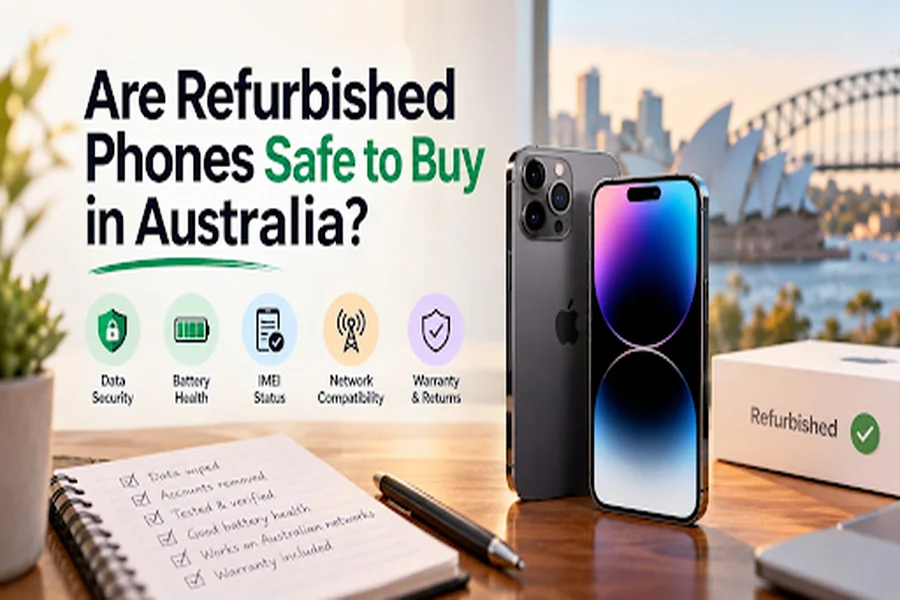
When you are considering a refurbished phone, you want to feel confident that it will protect your personal information, perform reliably and work properly on Australian networks. That confidence depends less on how impressive the phone looks and more on how carefully it has been prepared, tested and supported. So, are refurbished phones safe to buy in Australia?
Quick answer: Yes, a properly refurbished phone can be safe to buy when it has been securely data-wiped, cleared of previous accounts and tested for reliable use. A clear current IMEI status, suitable battery condition, current software support, Australian network compatibility and transparent warranty and return terms provide further confidence.
- When Are Refurbished Phones Safe to Buy?
- How Is a Refurbished Phone Prepared for Resale?
- What Should You Check Before Buying?
- Grade and Battery
- Account Locks and IMEI Status
- Software and Network Support
- Check the Model Number on Overseas Devices
- Warranty and Returns
- How Do You Choose a Trustworthy Seller?
- Refurbished-Phone Retailer or Private Seller?
- What Should You Check When the Phone Arrives?
- Confirm the Order
- Complete the Setup
- Test the Main Functions
- Keep the Purchase Information
- Are Refurbished Phones a Safe Choice in Australia?
When Are Refurbished Phones Safe to Buy?
A refurbished phone can be safe to buy when the seller has securely erased the previous user’s data, removed linked accounts and activation locks, checked the IMEI status and tested the phone’s essential functions before resale.
Its cosmetic grade explains its appearance, while its testing information shows how its battery, screen, cameras, audio, charging and connectivity have been assessed.
Australians exploring refurbished phone can use the following areas to evaluate a device:
| Area | What provides confidence |
| Data security | Secure erasure of the previous user’s personal information |
| Account status | Removal of linked Apple, Google or Samsung accounts and activation locks |
| Hardware | Testing of the battery, screen, cameras, audio, charging and connectivity |
| Device status | A current IMEI status that has been checked before resale |
| Compatibility | Suitable software support and Australian network functionality |
| Buyer protection | Clear condition information, warranty terms, returns and seller contact details |
These areas provide a practical answer to the question, “Are refurbished phones safe to buy?” Safety comes from the quality of the preparation and the information available about the individual phone.
How Is a Refurbished Phone Prepared for Resale?
A well-documented refurbishment process helps buyers understand what happened before a phone was offered for sale. Rather than focusing only on the number of checks, buyers should look at the stages and functions covered.
| Stage | What happens |
| Security | Previous accounts, activation locks and personal data are removed |
| Inspection | The screen, cameras, audio, buttons, charging and connectivity are tested |
| Condition | The battery and other components are assessed, with repairs or replacements completed where required |
| Final checks | The phone is cleaned, graded and tested again before sale |
Data erasure and account removal are separate steps. Data erasure clears photographs, messages, applications, files and settings, while account removal disconnects the device from its former owner.
For an iPhone, this includes signing out of the previous owner’s Apple Account and disabling Find My and Activation Lock. An Android phone should be disconnected from the previous Google or Samsung account so that Factory Reset Protection does not prevent the new owner from completing setup.
Buyers can ask the seller:
- How is personal data erased?
- How are account and activation locks checked?
- Which hardware functions are tested?
- Is the IMEI checked before resale?
- What battery standard must the phone meet?
- Are repaired functions tested again?
- Is a final inspection completed after grading?
The value of an inspection comes from the areas it covers, including account status, battery condition, software support, network eligibility and the phone’s key hardware functions.
Retailers such as Mobile Guru publish information about their testing, device conditions, battery standards and warranty terms, giving buyers a clearer view of how refurbished phones are prepared and supported.
What Should You Check Before Buying?
Once the preparation process is understood, the next step is to assess whether the individual phone suits your needs. Its grade, battery condition, account status, software support, network compatibility and purchase terms provide the clearest picture.
Grade and Battery
A condition grade generally describes cosmetic appearance. Terms such as “Premium”, “As New”, “Excellent”, “Very Good” and “Good” can indicate the expected level of marks or wear, although grade definitions can vary between sellers.
Battery condition is a separate consideration. A phone may retain its existing battery when it meets the seller’s published standard, while another may receive a replacement where required.
Useful battery information includes:
- The minimum battery-health standard for each grade.
- How battery condition and charging performance are tested.
- When the seller considers battery replacement.
- Whether battery-related faults are included in the warranty.
- Whether a replacement battery has been disclosed.
For example, Mobile Guru currently states a minimum battery health of 90%+ for its Premium refurbished iPhones and 80%+ for its other listed grades. These standards help buyers distinguish cosmetic condition from battery condition.
Battery information and available grades should also be checked on the individual listing when comparing refurbished iPhones or other phone models. Reading the complete grading information provides more clarity than relying on the grade name alone.
Account Locks and IMEI Status
A factory reset does not always remove the account protections linked to a phone. Buyers should confirm that Apple Activation Lock, Google Factory Reset Protection or any equivalent Samsung protection has been cleared.
The IMEI is a unique number used to identify a mobile device. An IMEI status check can show whether a handset is currently recorded as blocked on participating Australian mobile networks.
However, an IMEI check should not be treated as proof of ownership or a permanent guarantee of the device’s status. The Australian Mobile Telecommunications Association notes that there can be a delay between a phone being reported lost or stolen and its IMEI appearing as blocked.
Buyers should check that:
- The phone is free from previous-owner accounts.
- Find My or an equivalent device-tracking feature has been disabled.
- The phone can be activated with the buyer’s own account.
- The current IMEI status has been checked.
- The IMEI matches the supplied device information.
- All applicable IMEI numbers have been checked on a dual-SIM phone.
These checks help confirm that the phone is ready for its new owner to activate and use.
Software and Network Support
The manufacturer’s current support information should be checked for the specific phone model. Suitable operating-system and security support helps the phone remain compatible with current applications and everyday security requirements.
For use in Australia, buyers should confirm that the exact model:
- Supports the network technologies required by the intended Australian provider.
- Supports compatible 4G calling, including VoLTE where required.
- Can make standard and emergency calls on the intended network.
- Accepts the required physical SIM or eSIM.
- Is carrier-unlocked where required.
- Can receive relevant software and carrier updates.
Australia’s 3G mobile networks have been switched off. This makes the calling capabilities of older and overseas phones particularly important.
The Australian Government advises that some 4G phones may still be affected if they do not support Voice over LTE (VoLTE) or if they previously relied on 3G for emergency calls. Handsets operating on Australian mobile networks must also be able to access Triple Zero (000).
For this reason, seeing a 4G or 5G symbol on a phone is not, by itself, enough to confirm complete network and emergency-calling compatibility. Buyers should check the exact model with the intended Australian mobile provider.
Check the Model Number on Overseas Devices
Phones made for different regions can share the same product name while using different model numbers. An overseas version may have different network bands, SIM arrangements, software features or warranty eligibility.
Before buying, compare the exact model number with the manufacturer’s Australian specifications and the intended network provider’s compatibility information. This is more reliable than checking the phone name alone.
The seller should also clearly disclose whether a device is Australian stock or an overseas model. This allows buyers to check network compatibility and understand which support arrangements apply.
Warranty and Returns
Warranty and return terms explain what assistance is available after purchase. Buyers should review:
- The length of the warranty.
- The hardware and battery faults included.
- Coverage for replacement components.
- Any exclusions for accidental or liquid damage.
- The return window and applicable conditions.
- The available repair, replacement or refund options.
- The seller’s support and return-delivery process.
The warranty period alone does not provide the full picture. Buyers should also check what is covered, how to submit a claim and what support is available while the device is being assessed.
For example, Mobile Guru currently offers a 24-month seller warranty on its refurbished devices. Buyers should still read the complete warranty terms to understand the applicable coverage, exclusions and claim process.
How Do You Choose a Trustworthy Seller?
A trustworthy seller provides enough detail for buyers to make an informed decision. Helpful signs include:
- A published testing or refurbishment process.
- Clear condition-grade definitions.
- A stated minimum battery standard.
- Information about account and activation-lock removal.
- IMEI and network-status checks.
- Disclosure of Australian or overseas model numbers.
- An Australian business identity and contact details.
- Secure payment methods.
- Accessible warranty and return policies.
- Recent independent customer reviews.
- An invoice or other proof of purchase.
Clear written policies give buyers information they can review before ordering and refer to if they later need assistance.
Refurbished-Phone Retailer or Private Seller?
A refurbished-phone retailer may provide documented testing, condition grades, battery standards, IMEI checks, warranty terms and proof of purchase. Mobile Guru, for example, publishes information about its testing, grading, battery standards and warranty coverage.
With a private sale, the buyer may need to complete more of these checks independently. Before payment, it is useful to verify ownership information where possible, the phone’s current IMEI and account status, battery condition, physical condition and key functions, as well as any agreed return arrangements.
The key difference is therefore not simply whether a phone comes from a retailer or a private seller, but how much reliable information is available and which checks have already been documented.
Structured assessment processes can make these details easier to verify before a device is resold. Owners who are upgrading can also sell an old phone for assessment through a professional trade-in or buyback service rather than leaving an unused device stored away.
What Should You Check When the Phone Arrives?
Checking the device soon after delivery confirms that it matches the listing and performs as expected. A simple four-part check makes the process easier to follow.
Confirm the Order
- Check the model, model number, storage capacity and colour.
- Compare the cosmetic condition with the advertised grade.
- Confirm that the IMEI matches the invoice or supplied information.
- Photograph the device during unboxing to record its arrival condition.
Complete the Setup
- Check that the phone displays its normal setup screen.
- Confirm that no previous account or activation lock appears.
- Set it up using the new owner’s Apple, Google or Samsung account.
- Install available operating-system and security updates.
Test the Main Functions
- Insert or activate the intended Australian SIM or eSIM.
- Test calls, mobile data, Wi-Fi and Bluetooth.
- Check the touchscreen, cameras, microphones and speakers.
- Test the buttons, charging connection and biometric features.
- Observe battery charging and general performance.
Keep the Purchase Information
- Save the invoice and original product listing.
- Keep a copy of the grading, warranty and return terms.
- Note the return deadline.
- Retain the packaging until all checks are complete.
If the device does not match the listing or a function does not operate as expected, contact the seller within the stated return or support period.
Are Refurbished Phones a Safe Choice in Australia?
Yes, a properly prepared refurbished phone can provide a safe, reliable and practical everyday experience. Before ordering, confirm its testing process, battery standard, account status, current IMEI status, exact model number, Australian network compatibility, software support, warranty and return terms.
Mobile Guru is an Australian refurbished-phone retailer that publishes information about its testing, grading, battery standards and warranty terms to help buyers understand how its devices are prepared. Reviewing these details alongside the individual phone listing can help buyers choose a device whose condition, compatibility and purchase protection suit their needs.